 Add to Chrome
 Add to Firefox
 Add to Edge
Can Transformers Learn to Verify During Backtracking Search?
May 21, 2026
Backtracking search underlies classical constraint solvers, planners, and theorem provers. Recent transformer-based reasoning systems explore search trees over their own intermediate steps. A common training recipe fits an autoregressive next-token loss on offline solver traces. The model's input at each step is a cumulative trace of all prior decisions. The optimal continue-or-backtrack predictor depends only on the current search state, since two trajectories reaching the same state admit the same viable continuations. We show that decoder-only transformers trained on cumulative traces fail this requirement in two ways: the trace can scatter state features across many positions (scattered retrieval), and the predictor can condition on the trajectory rather than the state (history entanglement). We address scattered retrieval with localization, a trace-level fix that rewrites each decision block to expose state features locally. We address history entanglement with Selective State Attention (SSA), a fixed attention mask that enforces state-based decisions structurally without modifying training data, objective, or parameters. We focus on reactive verification, after propagation has exposed a contradiction. We test SSA on 3-SAT, graph coloring, Blocks World, and backtracking parsing. On same-state pairs that differ only in prior history, SSA emits identical decisions while a cumulative-trained causal baseline does not. Our contribution is a diagnostic of transformer behavior on serialized trajectory data, paired with a structural fix. Pretrained language models that search over their own reasoning steps may face the same failure. Our analysis opens up inference-time context clearing as a candidate way to apply the same isolation without retraining.

Training-Free Cultural Alignment of Large Language Models via Persona Disagreement
May 11, 2026Large language models increasingly mediate decisions that turn on moral judgement, yet a growing body of evidence shows that their implicit preferences are not culturally neutral. Existing cultural alignment methods either require per-country preference data and fine-tuning budgets or assume white-box access to model internals that commercial APIs do not expose. In this work, we focus on this realistic black-box, public-data-only regime and observe that within-country sociodemographic disagreement, not consensus, is the primary steering signal. We introduce DISCA (Disagreement-Informed Steering for Cultural Alignment), an inference-time method that instantiates each country as a panel of World-Values-Survey-grounded persona agents and converts their disagreement into a bounded, loss-averse logit correction. Across 20 countries and 7 open-weight backbones (2B--70B), DISCA reduces cultural misalignment on MultiTP by 10--24% on the six backbones >=3.8B, and 2--7% on open-ended scenarios, without changing any weights. Our results suggest that inference-time calibration is a scalable alternative to fine-tuning for serving the long tail of global moral preferences.
Fixed Budget is No Harder Than Fixed Confidence in Best-Arm Identification up to Logarithmic Factors
Feb 03, 2026The best-arm identification (BAI) problem is one of the most fundamental problems in interactive machine learning, which has two flavors: the fixed-budget setting (FB) and the fixed-confidence setting (FC). For $K$-armed bandits with the unique best arm, the optimal sample complexities for both settings have been settled down, and they match up to logarithmic factors. This prompts an interesting research question about the generic, potentially structured BAI problems: Is FB harder than FC or the other way around? In this paper, we show that FB is no harder than FC up to logarithmic factors. We do this constructively: we propose a novel algorithm called FC2FB (fixed confidence to fixed budget), which is a meta algorithm that takes in an FC algorithm $\mathcal{A}$ and turn it into an FB algorithm. We prove that this FC2FB enjoys a sample complexity that matches, up to logarithmic factors, that of the sample complexity of $\mathcal{A}$. This means that the optimal FC sample complexity is an upper bound of the optimal FB sample complexity up to logarithmic factors. Our result not only reveals a fundamental relationship between FB and FC, but also has a significant implication: FC2FB, combined with existing state-of-the-art FC algorithms, leads to improved sample complexity for a number of FB problems.
Time-varying Mixing Matrix Design for Energy-efficient Decentralized Federated Learning
Dec 30, 2025We consider the design of mixing matrices to minimize the operation cost for decentralized federated learning (DFL) in wireless networks, with focus on minimizing the maximum per-node energy consumption. As a critical hyperparameter for DFL, the mixing matrix controls both the convergence rate and the needs of agent-to-agent communications, and has thus been studied extensively. However, existing designs mostly focused on minimizing the communication time, leaving open the minimization of per-node energy consumption that is critical for energy-constrained devices. This work addresses this gap through a theoretically-justified solution for mixing matrix design that aims at minimizing the maximum per-node energy consumption until convergence, while taking into account the broadcast nature of wireless communications. Based on a novel convergence theorem that allows arbitrarily time-varying mixing matrices, we propose a multi-phase design framework that activates time-varying communication topologies under optimized budgets to trade off the per-iteration energy consumption and the convergence rate while balancing the energy consumption across nodes. Our evaluations based on real data have validated the efficacy of the proposed solution in combining the low energy consumption of sparse mixing matrices and the fast convergence of dense mixing matrices.
FLAT: Latent-Driven Arbitrary-Target Backdoor Attacks in Federated Learning
Aug 06, 2025Federated learning (FL) is vulnerable to backdoor attacks, yet most existing methods are limited by fixed-pattern or single-target triggers, making them inflexible and easier to detect. We propose FLAT (FL Arbitrary-Target Attack), a novel backdoor attack that leverages a latent-driven conditional autoencoder to generate diverse, target-specific triggers as needed. By introducing a latent code, FLAT enables the creation of visually adaptive and highly variable triggers, allowing attackers to select arbitrary targets without retraining and to evade conventional detection mechanisms. Our approach unifies attack success, stealth, and diversity within a single framework, introducing a new level of flexibility and sophistication to backdoor attacks in FL. Extensive experiments show that FLAT achieves high attack success and remains robust against advanced FL defenses. These results highlight the urgent need for new defense strategies to address latent-driven, multi-target backdoor threats in federated settings.
Acoustic scattering AI for non-invasive object classifications: A case study on hair assessment
Jun 17, 2025This paper presents a novel non-invasive object classification approach using acoustic scattering, demonstrated through a case study on hair assessment. When an incident wave interacts with an object, it generates a scattered acoustic field encoding structural and material properties. By emitting acoustic stimuli and capturing the scattered signals from head-with-hair-sample objects, we classify hair type and moisture using AI-driven, deep-learning-based sound classification. We benchmark comprehensive methods, including (i) fully supervised deep learning, (ii) embedding-based classification, (iii) supervised foundation model fine-tuning, and (iv) self-supervised model fine-tuning. Our best strategy achieves nearly 90% classification accuracy by fine-tuning all parameters of a self-supervised model. These results highlight acoustic scattering as a privacy-preserving, non-contact alternative to visual classification, opening huge potential for applications in various industries.
AsyncSwitch: Asynchronous Text-Speech Adaptation for Code-Switched ASR
Jun 17, 2025Developing code-switched ASR systems is challenging due to language ambiguity and limited exposure to multilingual, code-switched data, while collecting such speech is costly. Prior work generates synthetic audio from text, but these methods are computationally intensive and hard to scale. We introduce AsyncSwitch, a novel asynchronous adaptation framework that leverages large-scale, text-rich web data to pre-expose ASR models to diverse code-switched domains before fine-tuning on paired speech-text corpora. Our three-stage process (1) trains decoder self-attention and feedforward layers on code-switched text, (2) aligns decoder and encoder via cross-attention using limited speech-text data, and (3) fully fine-tunes the entire model. Experiments with Whisper on Malay-English code-switching demonstrate a 9.02% relative WER reduction, while improving monolingual performance in Singlish, Malay, and other English variants.
Can we train ASR systems on Code-switch without real code-switch data? Case study for Singapore's languages
Jun 17, 2025Code-switching (CS), common in multilingual settings, presents challenges for ASR due to scarce and costly transcribed data caused by linguistic complexity. This study investigates building CS-ASR using synthetic CS data. We propose a phrase-level mixing method to generate synthetic CS data that mimics natural patterns. Utilizing monolingual augmented with synthetic phrase-mixed CS data to fine-tune large pretrained ASR models (Whisper, MMS, SeamlessM4T). This paper focuses on three under-resourced Southeast Asian language pairs: Malay-English (BM-EN), Mandarin-Malay (ZH-BM), and Tamil-English (TA-EN), establishing a new comprehensive benchmark for CS-ASR to evaluate the performance of leading ASR models. Experimental results show that the proposed training strategy enhances ASR performance on monolingual and CS tests, with BM-EN showing highest gains, then TA-EN and ZH-BM. This finding offers a cost-effective approach for CS-ASR development, benefiting research and industry.
Qwen vs. Gemma Integration with Whisper: A Comparative Study in Multilingual SpeechLLM Systems
Jun 16, 2025This paper presents our system for the MLC-SLM Challenge 2025, focusing on multilingual speech recognition and language modeling with large language models (LLMs). Our approach combines a fine-tuned Whisper-large-v3 encoder with efficient projector architectures and various decoder configurations. We employ a three-stage training methodology that progressively optimizes the encoder, projector, and LLM components. Our system achieves competitive performance with a private test average WER/CER result of 16.63% using the Gemma3-12B and 18.6% using the Qwen2.5-7B as decoder-only language model.
CAMME: Adaptive Deepfake Image Detection with Multi-Modal Cross-Attention
May 23, 2025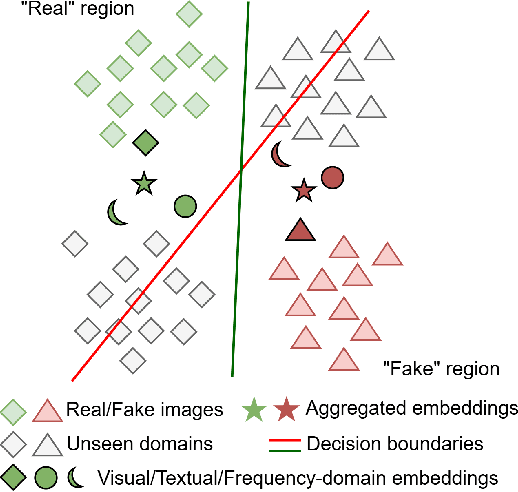

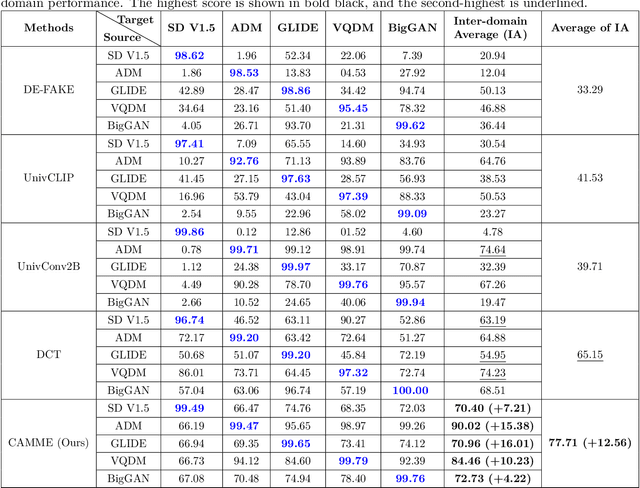
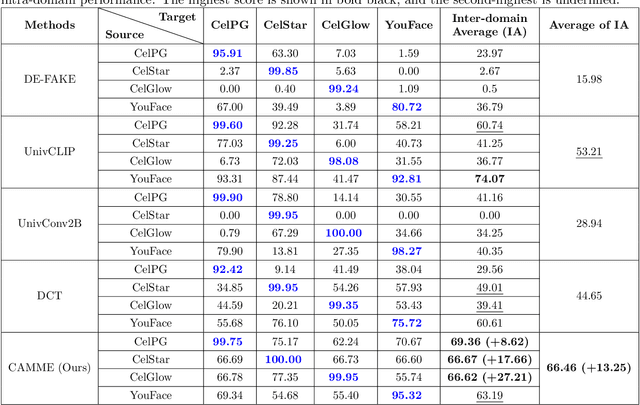
The proliferation of sophisticated AI-generated deepfakes poses critical challenges for digital media authentication and societal security. While existing detection methods perform well within specific generative domains, they exhibit significant performance degradation when applied to manipulations produced by unseen architectures--a fundamental limitation as generative technologies rapidly evolve. We propose CAMME (Cross-Attention Multi-Modal Embeddings), a framework that dynamically integrates visual, textual, and frequency-domain features through a multi-head cross-attention mechanism to establish robust cross-domain generalization. Extensive experiments demonstrate CAMME's superiority over state-of-the-art methods, yielding improvements of 12.56% on natural scenes and 13.25% on facial deepfakes. The framework demonstrates exceptional resilience, maintaining (over 91%) accuracy under natural image perturbations and achieving 89.01% and 96.14% accuracy against PGD and FGSM adversarial attacks, respectively. Our findings validate that integrating complementary modalities through cross-attention enables more effective decision boundary realignment for reliable deepfake detection across heterogeneous generative architectures.